Accelerating Innovation Through Team-Based Leadership
Topics: project management * change management * training
Format: on-going curriculum development & one-day on-site trainings
Team: project managers in large R&D org
The Challenge: Innovation Without Focus
In mid-2023, the Senior Director of Innovation at a large food-ingredients company faced a hard truth: innovation at her company wasn’t moving fast enough — and it wasn’t moving with purpose. Her 200-person R&D organization was overloaded: individuals were juggling too many projects at once with little ownership or accountability, and not enough structure to turn ideas into real outcomes.
She and I shared a common background in team-based engineering, and we quickly aligned on the root cause: a lack of clear team definition and leadership. She brought me in to help change that — to bring clarity, structure, and a culture of ownership to innovation projects through a new kind of leadership role.
The Solution: Building a Culture of Innovation Project Leadership
Together with her team, we created the role of Innovation Project Manager (IPM) — a new leadership designation embedded within existing roles like food scientists, business analysts, and program managers. These IPMs wouldn’t be solely project managers; they were the innovators, now with a clearer mandate to lead their teams. To encourage peer support, we decided to train them in cohorts of roughly ten IPMs at a time, and a waiting list quickly developed.
In developing this new role, we first began by defining what success looked like and co-developed a set of IPM values, behaviors, and responsibilities. These ranged from driving project execution with urgency, to fostering collaboration across silos, to maintaining customer-centricity. These principles would guide the first cohort and every cohort that followed.
In July 2023, we launched the first IPM training — a full-day, in-person session with a handpicked group of ten team members who had the right mix of ambition and influence. The training covered practical tools like Gantt charts and project charters, but more importantly, it focused on mindset and leadership: what it means to own a project, guide a team, and deliver results.
We used the in-person format to build relationships across the group, helping them see each other as allies, not just coworkers. That community-building proved essential as they forged this new path.
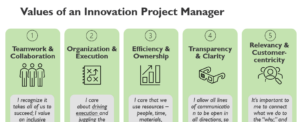
IPM Values as articulated by the team and shared in the training
Scaling and Evolving the Program
Over the next two years, we ran the training four more times, each iteration shaped by feedback and shifting organizational needs. We added a simulation where trainees tackled a fictitious construction project — a playful, low-stakes way to learn resource planning techniques without getting lost in technical details.
Beyond the classroom, we reinforced the growing IPM community with informal lunches, peer buddy systems, and one-on-one coaching. We stayed closely connected to provide targeted support, spot issues early, and continuously improve the program.
We also offered supplementary workshops to the IPMs on critical skills, like navigating difficult stakeholder conversations. After one external “challenging conversations” training, for example, we hosted a follow-up practice session where IPMs applied what they’d learned in realistic role-plays, turning theory into action.
Throughout the two years, I also served as a strategic advisor to this Innovation leader and her team, offering feedback on organizational changes and helping roll out new practices across the R&D function. Whether providing feedback on communications, facilitating team kickoffs, or designing off-site activities, the goal remained the same: make teamwork a deliberate, effective part of how innovation happened.
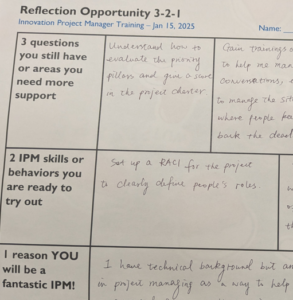
An IPM’s reflection at the conclusion of a training
The Results: From Chaos to Clarity
As a result of the work we did together, we achieved tangible impacts:
-
- Projects led by IPMs became more focused, better executed, and more likely to hit key milestones.
- IPMs emerged as trusted leaders, not just within their teams, but across the organization, increasingly called upon for high-visibility, strategic initiatives.
- The Innovation team began operating with a new rhythm: fewer dropped balls, more ownership, and stronger cross-functional alignment.
“Tiana has been a joy to work with and has had a huge impact on our company. I asked Tiana to help my group develop and implement a time sensitive, bespoke project management program for our innovation organization. Tiana jumped in, quickly understood our context, and then brought all her expertise to bear to develop an extremely successful program. I highly recommend working with Tiana!”
– Sr. Director of Innovation
Delivering Innovation with Intention
The success of the IPM program in this Innovation department went beyond skills training; by co-developing the program and nurturing it over time, we shifted the culture of innovation from individual effort to focused, team-driven execution. By embedding leadership within project teams, we created a repeatable model for clarity, accountability, and momentum.
With over 50 IPMs trained and supporting every critical project, the Innovation team now operates with greater cohesion, speed, and strategic alignment. These leaders are not only guiding projects to completion, they’re shaping how innovation happens across the organization.
The lesson is clear: innovation thrives not just on ideas, but on how we organize around them. And when the right people are equipped with the right tools and structure, powerful outcomes follow.
If you are looking to catalyze innovation and build stronger team accountability in your organization, let’s talk. A co-designed program like this can help your teams not just move faster, but move with purpose.