
Framing an “Approachable” Silo-Breaking Team Day
Topics: team-building * collaboration * engagement
Format: one-day off-site Team Day
Team: 16-member division in climate org
When she stepped up to lead the growing Tech Division of the climate organization, while her leader took on an Interim CEO role, the Division Leader knew her team was feeling the impacts of the changes. These shifts in team composition and leadership, coupled with a highly uncertain atmosphere around climate-related government incentives, external funding sources, and economic shifts, left the team unmoored and uneasy.
The Division Leader (we’ll call her DL) decided a Team Day was in order, both to tackle some of the communication and collaboration frictions she noticed, and also to have some fun and bond as a group. She’s someone who really enjoys team-building activities, but recognized that it’s not everyone’s cup of tea, so she wanted a day that would be engaging for everyone in the group, from the Interim CEO (let’s call her IC) to the college fellow.
Planning Toward Outcomes
We mapped out the desired outcomes for the day, which included:
- Improved team collaboration habits
- Effective delegation among team members including between managers and their direct reports
- Stronger intra- and interteam communication
- Increased team bonding and connectedness across the division
- Improved team morale in light of changes and uncertainty
My time planning the event with DL was important not just to select the right activities, but to understand the current relationships and dynamics in the group. For example, we did the Team Retrospective activity in their three functional sub-teams, because those are the groups that work most closely together day-to-day. On the other hand, some of the team-building activities were more about how each individual shows up and collaborates, so for those, we mixed up the groups to get folks working with a variety of colleagues throughout the day.
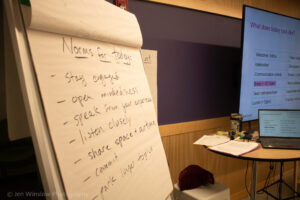
The day starts with review of the day’s agenda and group norm setting for how to make the best day possible.
I carefully mapped out the timing of the day and the sequence of activities, to make sure that we had a good mix of discussion-based and more active hands-on sessions. I took into account when energy dips after lunch and how often a break was necessary (and that some little snacks should be available). In my own notes, I even tracked how to rearrange the tables and chairs at different points in the day and when to set up the particular materials for each activity. I built in some buffer time, in the event that a debrief of an activity got unexpectedly juicy and warranted more time. The team didn’t see all this minutiae, but those are the logistics that make for a smooth and seamless day for them.
Engaging Leadership
Given the shifting leadership roles, it was important that both DL and IC be enmeshed in the day as participants. We set aside a 40-minute chunk toward the end of the day for a “Fireside Chat with Leadership,” during which the two of them would share some perspectives on where the organization was going, the impacts of broader industry trends, and how their roles would evolve when the new CEO arrived. This conversation was well-received, giving the team an opportunity to ask some questions that they may have been quietly wondering but not had an occasion to voice aloud.
Aside from that segment, however, it was important that the leaders engage with the activities as participants, not leaders. They joined into each team-building activity and collaborated on equal footing with the rest of the team members. DL and IC also made a point to wait for others to speak first in the debriefs of activities before weighing in. As thoughtful leaders, they knew the degree to which their perspectives might shut down those of more junior members, so they knew to hang back and let the team chime in first.
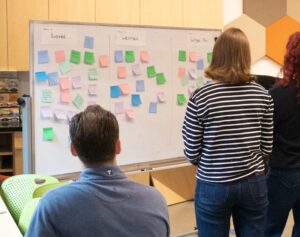
Team members discuss actions based on Team Retrospective reflections.
Leaving with Actions
The relevance of a Team Day isn’t to have an enjoyable time together (though I love that outcome too), but rather to have some insights and leave with clear actions to improve teamwork and achieve more together. Early in the day, we did a Team Retrospective, which highlighted areas that the teams thought could be improved in their ways of working – meeting effectiveness, ways to co-work even on non-office days, ways to cross-pollinate and share information better between sub-teams.

Preparing the boards for functional sub-teams to do Team Retrospectives.
After completing a variety of activities, we ended the day with some time dedicated to articulating the actions the team would take next. These were framed as experiments, because there’s no way in that moment to know that they are the correct actions. Rather, the idea is to make a hypothesis about how these changes will improve the work and to identify a timeframe and criteria for assessing whether the changes are helping. So the team thought back over the takeaways from the Retrospective, as well as the insights they gleaned from the hands-on activities, and framed some experiments in their team habits that they could implement right away. They shared them with the larger group, for awareness and accountability, so the outputs of the Team Day would actually stick.
In a post-event survey, team members appreciated “Continuing to break down silos between teams” and were excited to try out “delegation of work based off strengths and open communication” among other changes to how they structure their work. When asked “Would you recommend a Team Day like this to another team in a similar situation to yours?” 100% of respondents answered 5 out of 5. “This was AWESOME” said one participant after the event.

I enthusiastically brief the team on the next team-building activity
“I really appreciated how your approach and your curriculum are approachable to all levels of professionals. I’ve done a similar training type day in the past, but it was more focused on leaders and leadership, and would not have been as approachable as your style and your content, so just thank you. I’ve heard such positive things from people on the team already.” – Division Lead
In a debrief almost two weeks later, the leadership of the group shared what changes they were already seeing. Some very tactical changes were made to meeting timing and agendas, to make better use of together-time, with the action-items from the Team Day captured and shared for accountability. One team used the Retrospective tool to host another such session to catch a different segment of team members. And the impact of the team bonding showed up in some cross-team coworking sessions on remote days. The leaders said the team was already pretty collaborative but the day had further broken down the silos in the division and strengthened bonds.
If your team is struggling through leadership changes or feeling the friction of silos and meeting bloat, consider booking a facilitated Team Day to refresh team spirits and co-design actionable experiments toward better ways of working together.